
DIY Safety
Commercial-Grade vs Retail Christmas Lights
How commercial-grade and retail Christmas lights differ in cable, connectors, weather rating, replaceable parts and run length.
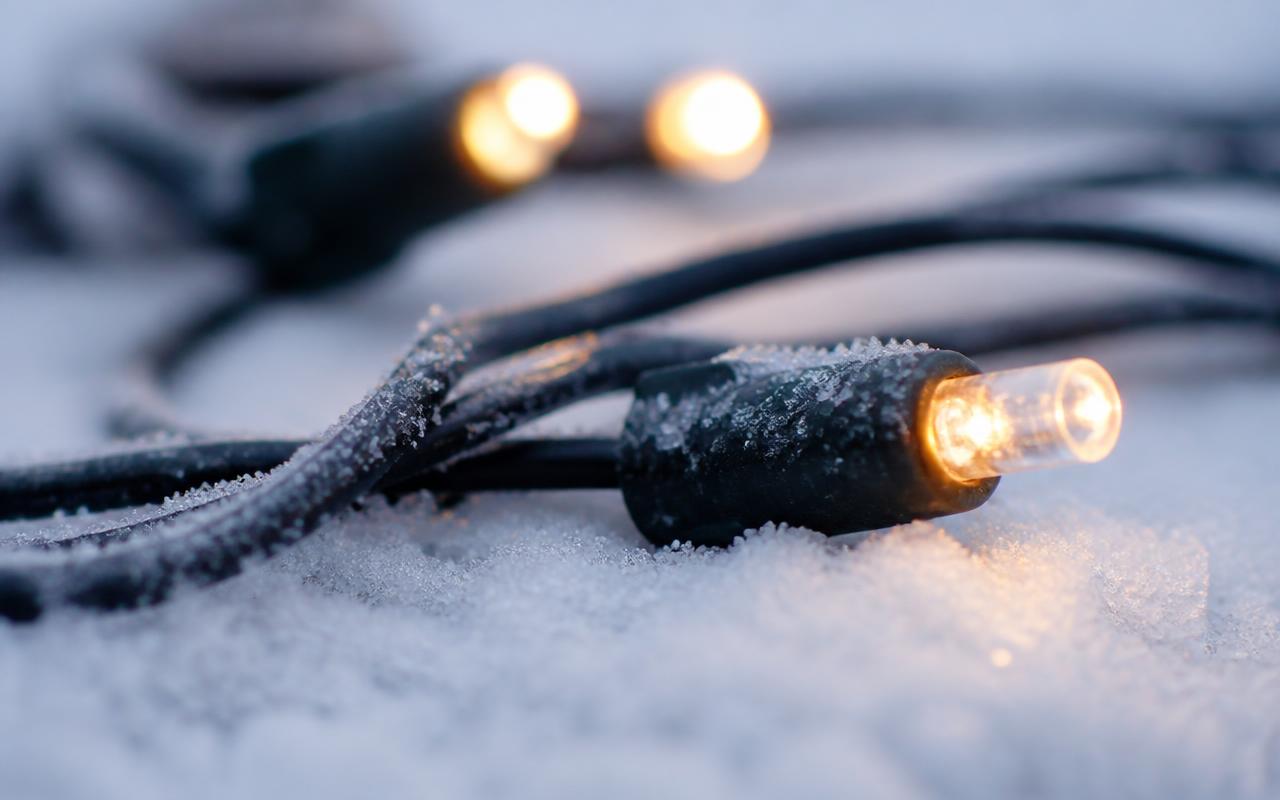
Commercial-grade Christmas lights differ from retail sets in wire gauge, weatherproofing, voltage and lifespan — and that difference is why one strand fails by the second weekend of December while the other survives seven British winters. This is what separates the two, and why we install only the commercial kind.
The two industries hiding inside one product
Boxed retail sets exist to hit a low retail price during a six-week window — cheap, acceptable on the shelf, built to survive being plugged in once. A second, almost invisible market — commercial-grade Christmas lights — supplies hotels, royal estates, town councils and professional installers, sold by the hundred-foot reel, at five to ten times the price per metre, designed to be installed at height in British weather for years. We use the second category exclusively.
What "commercial grade" actually means
Wire gauge
- Retail lights
- Thin (22–24 AWG)
- Commercial-grade lights
- Heavy (18 AWG, often rubber-jacketed)
Bulb housing
- Retail lights
- Press-fit plastic
- Commercial-grade lights
- Sealed, replaceable, UV-stable
Weather rating
- Retail lights
- IP44 at best, often unrated
- Commercial-grade lights
- IP65–IP67, fully outdoor-rated
Voltage
- Retail lights
- 230V mains direct
- Commercial-grade lights
- 24V or 31V low-voltage step-down
Lifespan
- Retail lights
- 1–2 seasons
- Commercial-grade lights
- 5–7 seasons in continuous outdoor use
Connector
- Retail lights
- Moulded plug, single piece
- Commercial-grade lights
- Sealed, gasketed, daisy-chainable
| Spec | Retail lights | Commercial-grade lights |
|---|---|---|
| Wire gauge | Thin (22–24 AWG) | Heavy (18 AWG, often rubber-jacketed) |
| Bulb housing | Press-fit plastic | Sealed, replaceable, UV-stable |
| Weather rating | IP44 at best, often unrated | IP65–IP67, fully outdoor-rated |
| Voltage | 230V mains direct | 24V or 31V low-voltage step-down |
| Lifespan | 1–2 seasons | 5–7 seasons in continuous outdoor use |
| Connector | Moulded plug, single piece | Sealed, gasketed, daisy-chainable |
The last row matters most. Retail lights end in a single household plug. Commercial lights link end-to-end, so an entire roofline runs from one discreet, weather-sealed power source — no exposed extension leads taped to drainpipes, no daisy-chain of moulded plugs poking out of gutters.
Why this matters when it is dark and raining in Surrey
Christmas in the UK is wet, windy, freezes overnight and thaws by lunchtime. Cheap lights fail in three predictable ways:
- Water ingress at the bulb housing. The plastic cap pops, water gets in, the LED corrodes, the strand goes black halfway along.
- Connector failure at the plug. An ungasketed moulded plug cracks in the first cold snap and the fuse blows.
- UV brittleness. Cheap PVC degrades fast in winter sun; within one season the wire near the eaves is hard, dull and brittle, and splits the next year.
Commercial-grade strands are built to ignore all three: sonically welded bulb housings, gasketed locking connectors, and a UV-stabilised jacket rated -25°C to +40°C.
Why we run everything on low voltage
Our installations use 24V or 31V transformers, sited indoors or in a sealed weatherproof box, with only low voltage running through the outdoor strands.
- Safety
- A low-voltage strand on a wet wall is a different risk profile to 230V on a wet wall
- Longevity
- Bulbs run cooler and last longer
- Run length
- 60–100 metres of strand on a single transformer without performance loss; shop-bought lights would trip the breaker
"But the box says LED — isn't it the same?"
No. LED is the bulb technology, not the product — a cheap LED string and a commercial LED string are as different as a plastic kettle and a copper espresso machine. The differences you can't see in the box: the driver chip (uniform colour temperature versus inconsistent colour), the lens material (stable polycarbonate versus plastic that yellows), and the phosphor coating (stable for years versus colour drift after one season).
Stand on the pavement on a December evening and the result is obvious: a premium installation shows one consistent warm white across the whole roofline, while cheap lights look patchy — some bulbs blue-tinted, some yellow, some already dimming.
What this looks like on a real London house
When we quote a project, we price more than the box of lights:
- Heavy-gauge, IP67-rated commercial strand, priced per metre
- Low-voltage transformer sized to the run length
- Weatherproof connector chain
- Gutter, brick and tile clips chosen for the specific surface
- A safe, hidden power feed
- Take-down, drying, testing and storage at season end
The lights themselves are the visible 30%. The other 70% is what keeps them up, lit, safe and alive into next year.
What to ask any installer
- What voltage do you run? Correct answer: low voltage, 24V or 31V, via a transformer.
- What's the IP rating of your strands? Correct answer: IP65 minimum, IP67 preferred.
- Is the lighting hired or mine? Both are offered — seasonal hire is the default and a purchase option is available — but the answer should be clear, and either way the lights should be commercial grade, not retail.
A vague answer to any of these means you're talking to someone reselling basic retail products.
The honest bottom line
A boxed retail set is a perfectly reasonable thing to put on your tree for a few weeks. What it cannot do is professionally light a roofline, a mature outdoor tree, a long façade or a period property — the product isn't built for it, and it will fail, often at the worst moment. We exist for the homes where that isn't an option: where the lights need to look perfect from first switch-on to Twelfth Night, regardless of weather, every year.
Want lights that won't fail in December rain? Request your tailored Christmas lighting quote →
Related reading
Ready when you are
Want it done properly this season?
We design, install, maintain and take down the display across London and the South East. Send three clear photos and we'll price it.
Where to go next
More on diy safety
- Why DIY Christmas Lights Aren't Worth the RiskThe honest case against climbing your own roof in December — insurance gaps, ladder accidents, and what a professional carries that you don't.
- Waterproof Outdoor Christmas Lights: IP Ratings ExplainedWhat IP44, IP65 and IP67 actually mean for your Christmas lights, and why the connectors — not the bulbs — are what fail in a wet British December.
- How to Fix Christmas Lights Without Damaging Your HouseWhy staples and nails ruin houses, what a careful installer does instead, and the questions to ask before anyone climbs.