
DIY Safety
Waterproof Outdoor Christmas Lights: IP Ratings Explained
What IP44, IP65 and IP67 actually mean for your Christmas lights, and why the connectors — not the bulbs — are what fail in a wet British December.
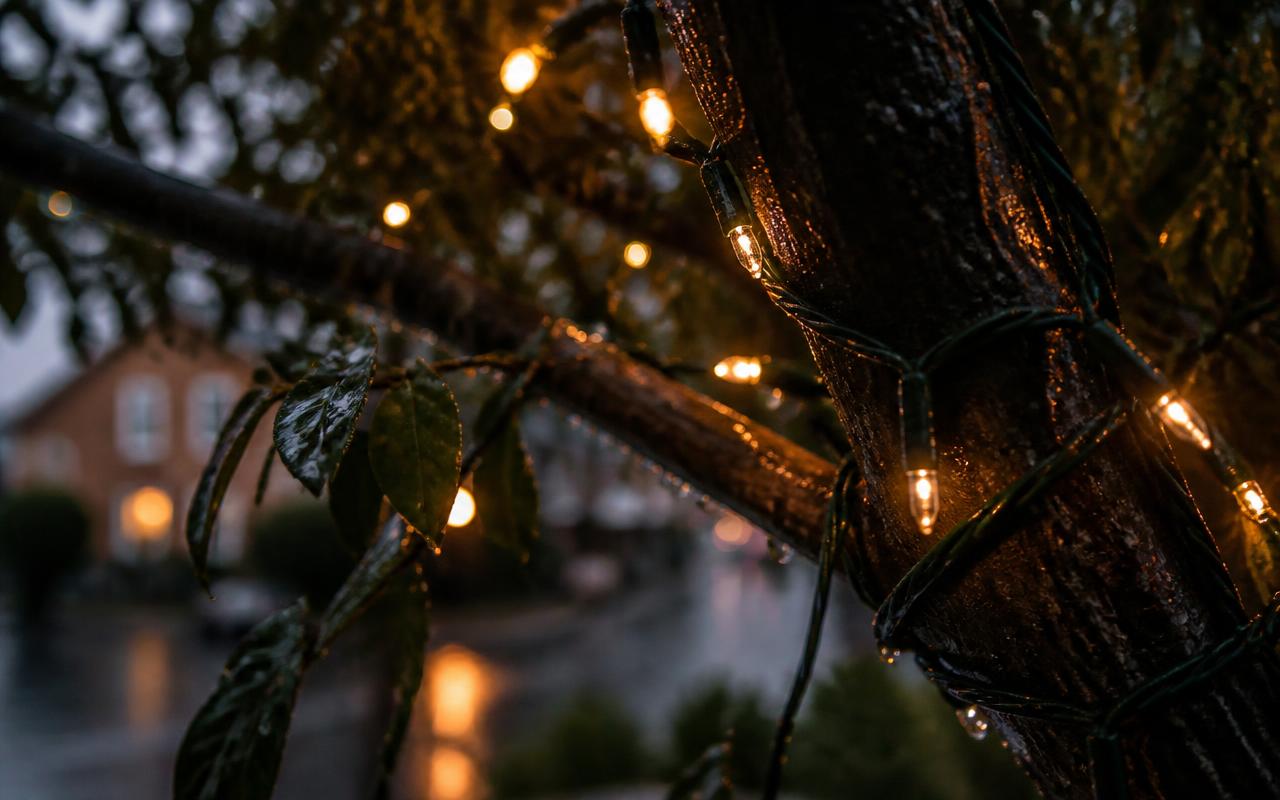
"Outdoor" lights and "waterproof" lights are not the same thing — most supermarket outdoor sets are only rated IP44, splash-resistant at best. A genuinely waterproof set for a British winter needs IP65 minimum, sonically welded bulbs, gasketed connectors, a potted driver, and low-voltage operation.
The single most useful number: the IP rating
Every electrical product sold in the UK has an IP rating — two digits, the first for dust, the second for water. For Christmas lights, only the second digit matters.
IP20
- Means
- Indoor only, no water protection
- Suitable for
- Tree lights inside the house
IP44
- Means
- Splashes from any direction
- Suitable for
- Covered porches, sheltered windows
IP54
- Means
- Light spray
- Suitable for
- Sheltered facades only
IP65
- Means
- Low-pressure water jets from any angle
- Suitable for
- True outdoor — eaves, walls, trees
IP67
- Means
- Temporary submersion up to 1m
- Suitable for
- Ground level, paths, trees, anywhere wet
IP68
- Means
- Continuous submersion
- Suitable for
- Pond and pool installations
| IP rating | Means | Suitable for |
|---|---|---|
| IP20 | Indoor only, no water protection | Tree lights inside the house |
| IP44 | Splashes from any direction | Covered porches, sheltered windows |
| IP54 | Light spray | Sheltered facades only |
| IP65 | Low-pressure water jets from any angle | True outdoor — eaves, walls, trees |
| IP67 | Temporary submersion up to 1m | Ground level, paths, trees, anywhere wet |
| IP68 | Continuous submersion | Pond and pool installations |
Why "outdoor" lights from a shop still fail
Most boxed "outdoor Christmas lights" sold at supermarkets are IP44 — fine for a passing shower on a sheltered surface with dry connectors. A British December provides none of that:
- 12+ hours of continuous rain
- Wind driving water sideways under eaves
- Frost that freezes water inside connectors and forces them open
- Snow sitting on horizontal runs, slowly soaking every cap
An IP44 strand draped on a roofline will fail. The only question is when.
The three failure points to check
Bulb housing
- Cheap version
- Press-fit with a rubber O-ring that fails after freeze-thaw cycles
- Commercial-grade version
- Sonically welded — bulb housing and wire jacket fused into one sealed unit, no seam
Connector
- Cheap version
- Moulded plug with rubber seals that harden and let water in
- Commercial-grade version
- Gasketed locking connector, silicone seal, twist-and-lock, marine-grade
Transformer / driver
- Cheap version
- Vented plastic housing that dies on first contact with water
- Commercial-grade version
- Fully potted, IP67-rated — electronics sealed in epoxy resin
| Component | Cheap version | Commercial-grade version |
|---|---|---|
| Bulb housing | Press-fit with a rubber O-ring that fails after freeze-thaw cycles | Sonically welded — bulb housing and wire jacket fused into one sealed unit, no seam |
| Connector | Moulded plug with rubber seals that harden and let water in | Gasketed locking connector, silicone seal, twist-and-lock, marine-grade |
| Transformer / driver | Vented plastic housing that dies on first contact with water | Fully potted, IP67-rated — electronics sealed in epoxy resin |
The connector is where roughly 80% of real-world failures happen. We test every connector on every install with a hose before sign-off.
Why low voltage is part of waterproofing
A 230V mains-powered strand exposed to weather relies entirely on its IP rating to keep water from a live conductor — failure ranges from a tripped breaker to fire or shock. A 24V low-voltage system is a different risk category: even a flooded connector stays below the threshold for serious harm.
What a properly waterproofed install looks like
When the work is done right, you see almost nothing beyond the bulbs and the soft glow at dusk. Everything else — wire run, connectors, power feed, driver — is hidden, sealed and inaccessible to weather. Specifically, there should be:
- No visible extension leads
- No moulded household plugs taped to drainpipes
- No exposed connectors at gutter corners
- No power supply sitting on the lawn
- No "spare" cable looped around a hook for next year
If you can see any of those on a neighbour's house, it's a DIY install or a low-end retail product — usually the house with one dark patch on the eaves by mid-December.
A note on cheap "waterproof" lights online
Marketplace searches for "IP67 Christmas lights" return thousands of products at supermarket prices, but there's no UK enforcement of IP claims on imported decorative lighting. The only reliable way to know a strand is genuinely IP67 is to buy from a manufacturer that supplies the commercial trade and stands behind a multi-year warranty — we're happy to say exactly which we use when we quote.
The checklist
- IP rating
- IP65 minimum, IP67 preferred
- Bulbs
- Sonically welded
- Connectors
- Gasketed, locking
- Driver
- Sealed and potted
- Voltage
- Low voltage (24V)
When all five are in place, your lights run through every storm, freeze and thaw the British winter throws at them — and are still glowing, steady and bright on the night you most want them to be.
Want a Christmas display that survives a wet British winter? Request your tailored quote →
Related reading
Ready when you are
Want it done properly this season?
We design, install, maintain and take down the display across London and the South East. Send three clear photos and we'll price it.
Where to go next
More on diy safety
- Why DIY Christmas Lights Aren't Worth the RiskThe honest case against climbing your own roof in December — insurance gaps, ladder accidents, and what a professional carries that you don't.
- Commercial-Grade vs Retail Christmas LightsHow commercial-grade and retail Christmas lights differ in cable, connectors, weather rating, replaceable parts and run length.
- How to Fix Christmas Lights Without Damaging Your HouseWhy staples and nails ruin houses, what a careful installer does instead, and the questions to ask before anyone climbs.