
DIY Safety
How to Fix Christmas Lights Without Damaging Your House
Why staples and nails ruin houses, what a careful installer does instead, and the questions to ask before anyone climbs.
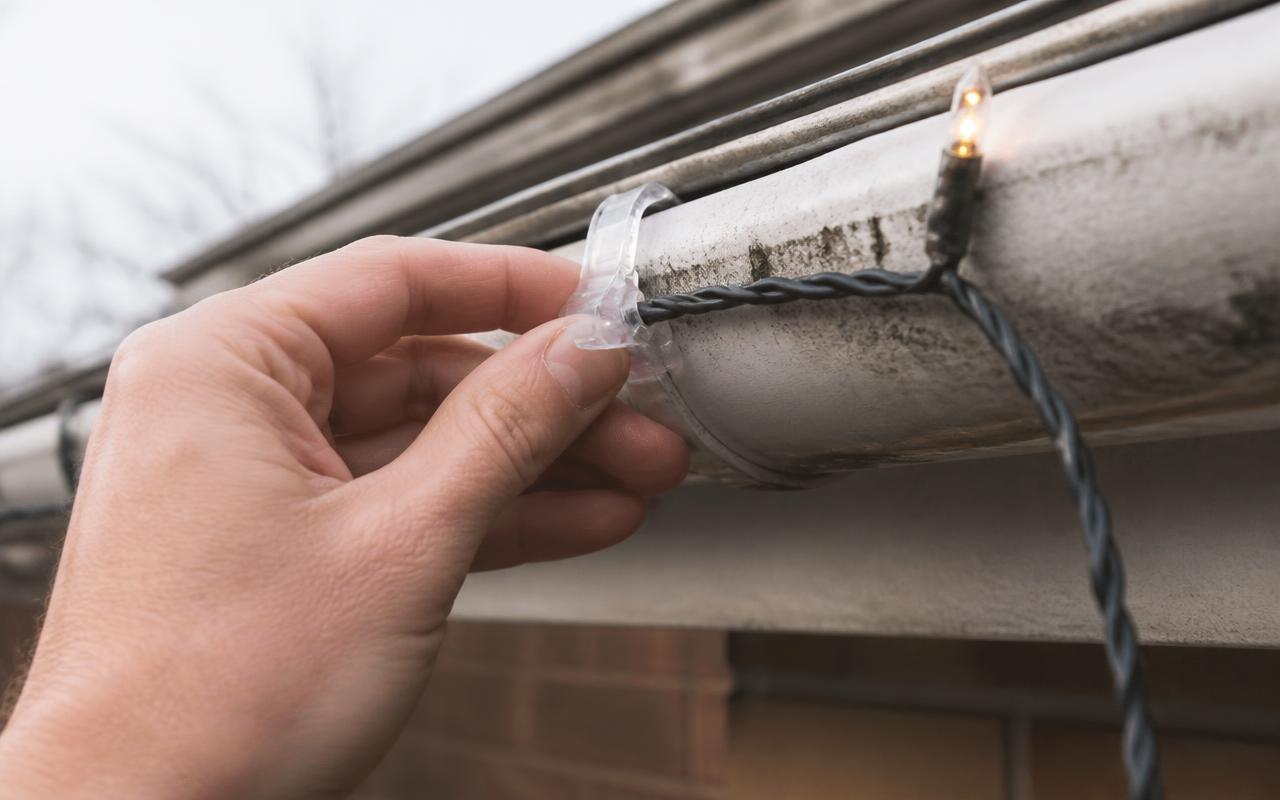
Use non-invasive fixings suited to the surface. Never staples, never nails, never adhesive on porous surfaces. That is the whole answer — the rest of this guide is why.
Why staples are always wrong
- They pierce the cable insulation. A staple driven over a cable will eventually cut the outer jacket. Once water gets in, the strand fails — or becomes live to anything it's touching.
- They damage the surface. Wooden fascia, soft brick and render all show staple holes for years. Insurance valuers notice.
- They cannot be removed cleanly. Pulling a staple from a fascia in January takes a chisel and a careful hand — most people don't bother, and the fascia is left peppered with old holes.
Why nails are wrong
The same problem, with larger holes. A nail through a cable is dangerous immediately, not just eventually, and a nail driven into wet wood near a cable will rust into the fascia and stay there for thirty years.
The right approach: non-invasive, judged on site
The right fixing depends on the surface, its condition and how exposed it is — something an installer judges up close on the day, not from a photo. Non-invasive runs leave the house unmarked, but they are significantly more vulnerable to storm gusts, winter winds and heavy rain, so they need checking through the season.
Removal
A properly fixed non-invasive installation comes off cleanly and leaves no marks. A stapled or nailed installation needs a day's work in January, leaves visible damage, and is often abandoned halfway — look up at any street in February and the DIY jobs are obvious.
How we work
Non-invasive first, judged on site, and the house should look identical after take-down to before installation.
Questions to ask an installer
- How will you protect my house?
- Do you ever use staples or nails?
- What does the house look like after takedown?
Want a clean installation that respects your home? Request a tailored quote →
Related reading
Ready when you are
Want it done properly this season?
We design, install, maintain and take down the display across London and the South East. Send three clear photos and we'll price it.
Where to go next
More on diy safety
- Why DIY Christmas Lights Aren't Worth the RiskThe honest case against climbing your own roof in December — insurance gaps, ladder accidents, and what a professional carries that you don't.
- Commercial-Grade vs Retail Christmas LightsHow commercial-grade and retail Christmas lights differ in cable, connectors, weather rating, replaceable parts and run length.
- Waterproof Outdoor Christmas Lights: IP Ratings ExplainedWhat IP44, IP65 and IP67 actually mean for your Christmas lights, and why the connectors — not the bulbs — are what fail in a wet British December.